
Non-Drug Depression Treatment: Not Everyone Needs Medication, Nor Self-Care Alone | Safe and Sound
Non-pharmacological treatments for depression are a popular option for those seeking to improve their mental health but hesitant about using antidepressants. Many hope that simply changing their lifestyle, thinking positively, or overcoming difficulties through willpower will be enough to recover.
However, not everyone needs medication, but neither can everyone treat themselves without professional support. Understanding the role of non-drug treatments will help patients choose the right support and avoid unrealistic expectations during their mental health recovery.
What are non-drug treatments for depression?
Non-pharmacological treatments for depression are a group of methods that support patients in improving their emotions, behaviors, and ability to adapt to life without relying primarily on medication. It's important to understand that non-pharmacological treatment does not mean trying to overcome depression alone.
 Many methods, such as psychotherapy, are still implemented according to clear professional procedures, with specific goals and tailored to the needs of each patient. The goal is not only to reduce feelings of sadness but also to help patients better understand the difficulties they are experiencing, restore daily activities, and build long-term support resources for their mental health.
When should non-drug treatments be considered?
Many people worry that being diagnosed with depression means they have to take antidepressants. In reality, the decision to treat with medication depends on many different factors and needs to be assessed based on each individual's specific condition.
In some cases, non-pharmacological methods may be preferred, such as when:
Non-pharmacological treatments may be considered when:
- Symptoms of depression are still mild: patients can still function, study, or work at a relatively stable level, despite feelings of sadness, fatigue, or decreased interest.
- Psychological difficulties have not yet seriously affected daily life: symptoms have appeared but have not significantly disrupted work, studies, self-care, or relationships.
- Patients still have resources to support them: family, friends, mental health professionals, or their living environment can accompany, listen to, and support them during the recovery process.
- Closely monitoring symptom progression is important: the patient's condition needs to be observed over time so that treatment can be adjusted if symptoms do not improve.
- Treatment plans should be tailored to individual circumstances: support methods should be based on each person's needs, tolerance levels, ability to participate in therapy, and practical conditions.
However, this does not mean that medication is always excluded from treatment. In some situations, antidepressants may be considered by a doctor as part of a treatment plan, especially when symptoms are prolonged, worsen, or significantly affect daily life.
Medication may be considered when:
- Depressive symptoms persist or tend to worsen.
- Work, studies, or relationships are significantly affected.
- Patients face significant difficulties in maintaining their daily activities.
- There is a risk related to health or safety.
- Combining medications is considered necessary to support more effective recovery.
Regardless of whether medication is chosen or not, patients should not make decisions on their own or stop taking medication without a doctor's prescription. Taking medication does not reflect weakness or a lack of effort, but rather a professional decision made based on individual treatment needs, symptom severity, and recovery goals.
Non-pharmacological treatments for depression are commonly used.
The methods below should not be understood as "self-help tips for depression," but rather as supportive approaches that can help patients gradually understand their condition, restore their rhythm of life, and rebuild the resources necessary for recovery.
- Psychotherapy: Through working with a psychologist or therapist, patients can identify the thoughts, feelings, and behaviors that are contributing to their current difficulties. Therapy not only helps patients "stop feeling sad" but also helps them understand what is happening to them and develop more appropriate coping mechanisms.
- Adjusting sleep and routines: When sleep is poor or routines are disrupted, negative emotions are more likely to become apparent. Therefore, gradually rebuilding a stable routine is a crucial part of the recovery process, not just general lifestyle advice.
- Physical health care: When the body is frequently fatigued, lacking energy, or eating irregularly, patients may find it difficult to participate in activities necessary for recovery. Appropriate physical care helps create a better foundation for patients to continue their treatment.
- Appropriate physical activity: Exercise doesn't necessarily have to be high-intensity workouts. For those with depression, short walks, light indoor exercise, or simply going outside for fresh air can be a valuable first step. Increased social support: Maintaining connections with family, friends, or professionals can help reduce isolation and provide support during recovery.
>> See also: How to treat depression at home: Practical support strategies
How is non-drug treatment different from trying to overcome it on your own?
Non-drug treatments and trying to overcome challenges alone are actually two very different approaches. It's worth noting that many people seek support not because they lack willpower, but because previous personal efforts have become insufficient to improve their current situation.
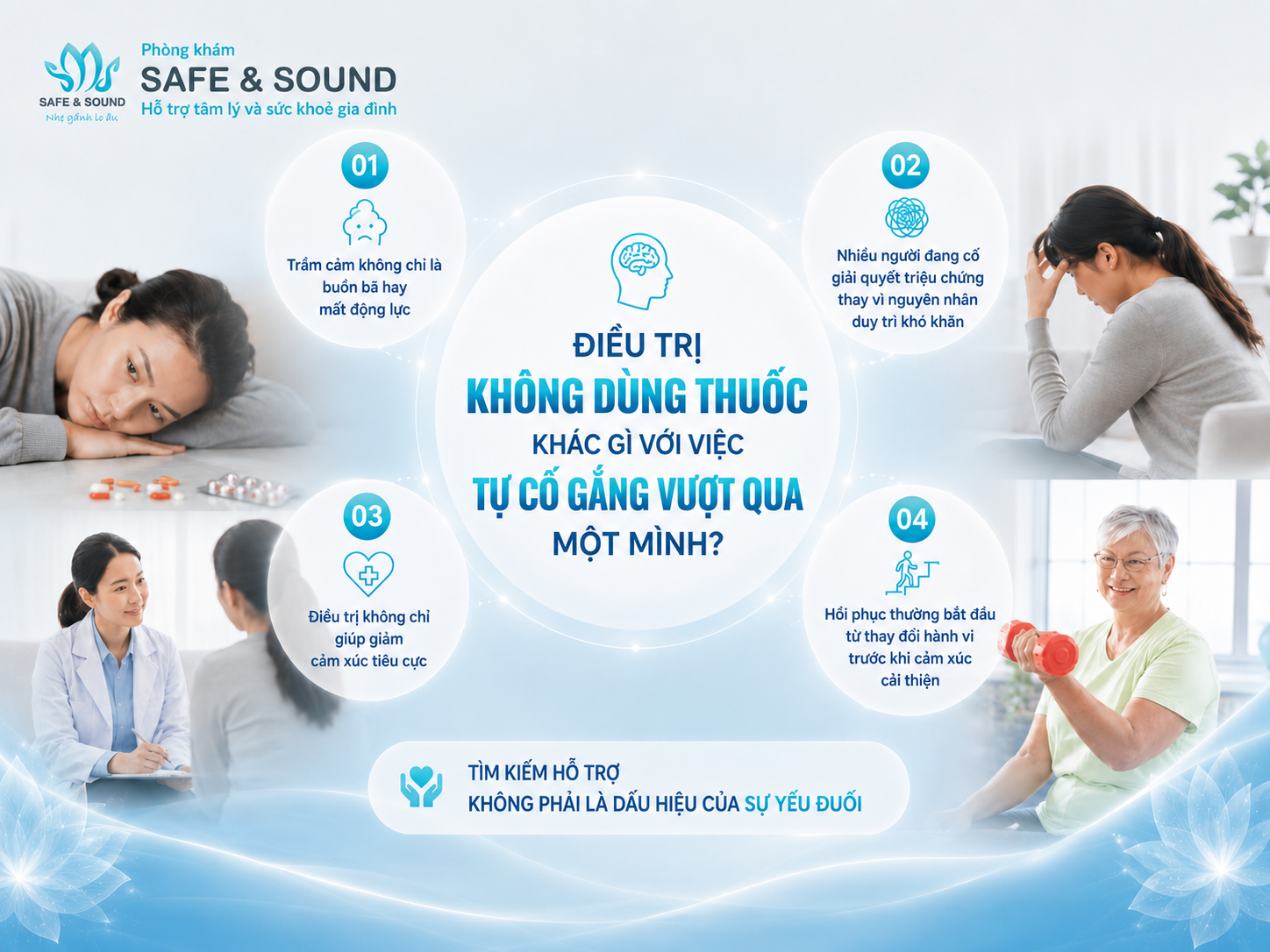 The difference lies in the fact that non-drug treatment still requires clear direction, monitoring, and goals. Patients are not left alone with their emotions but are supported in understanding what is sustaining their current difficulties and gradually rebuilding their ability to participate in life.
|
Aspect |
Try to overcome it on your own. |
Non-drug treatment |
|
Way of looking at the problem |
I often think I need to try harder, be stronger, or overcome it myself. |
View depression as a condition that needs to be understood and supported properly. |
|
Main objective |
How to feel less sad and tired as quickly as possible? |
Reduce symptoms, restore activity, and build long-term recovery resources. |
|
How to handle it |
It's easy to avoid the issue, endure it, blame yourself, or force yourself to think positively. |
There are support plans tailored to individual situations, needs, and circumstances. |
|
The role of the patient |
Dealing with emotions and pressure all alone. |
Actively participate in the recovery process, but provide support when needed. |
|
Expected results |
It might provide temporary relief, but it's easy to fall back into the same trap. |
Aiming for more sustainable change in emotions, behavior, and lifestyle. |
Reason 1: Depression is not just about feeling sad or lacking motivation.
Many people think depression is simply prolonged sadness or a lack of motivation. But in reality, this condition can affect many aspects of life simultaneously: sleep, energy levels, concentration, self-perception, and the ability to maintain daily activities.
When trying to cope alone, patients often focus on the question, "How can I stop feeling sad?" Non-drug treatments, however, offer a broader perspective:
- Why are patients losing energy?
- What causes them to become less active, withdrawn, or avoidant?
- What habits, thoughts, or pressures are prolonging this condition?
- What aspects of recovery does the patient need to achieve first in order to return to a more stable life?
The key point is that the symptoms of depression often interact with each other. When fatigued, patients tend to reduce their activity. When they reduce their activity, they lose out on positive experiences. With fewer positive experiences, negative emotions are more likely to persist.
Reason 2: Many people are trying to reduce immediate discomfort but haven't yet addressed the factors that sustain the discomfort.
Before seeking support, many people try a lot. They try to be busier, force themselves to be happy, ignore negative emotions, or tell themselves that everything will pass. These methods may help them cope in the short term, but they don't necessarily lead to true recovery.
The problem is that many individual efforts focus only on "how to alleviate discomfort right now." Meanwhile, non-drug treatments need to help patients recognize the factors that are causing the difficulties to recur, such as the following:
- Withdraw from important relationships.
- Reject activities that once brought a sense of meaning.
- Avoiding daily work, studies, or responsibilities.
- Blame yourself whenever you can't improve as quickly as you'd like.
- There is a lack of a proper monitoring and adjustment plan.
For example, avoidance might provide short-term stress relief for patients. But if avoidance continues, they may lose connection and their sense of accomplishment and feel even more isolated. This is a cycle that simply "trying harder" is often not enough to break.
Reason 3: Non-drug treatments are not just about making negative emotions disappear.
A common misconception is that treatment is only effective when the patient is no longer sad, tired, or has negative thoughts. In reality, recovery often begins with smaller changes: sleeping better, getting out of bed more easily, maintaining a daily activity, or reconnecting with a trusted person.
Non-drug treatments can support patients step by step:
- To understand better what I am going through.
- Resuming activities that have been interrupted.
- Rebuild supportive relationships.
- Improve your ability to cope with life's pressures.
- Regain a sense of control instead of being swept away by symptoms.
For many people, the important change isn't the complete disappearance of all negative emotions. More importantly, it's about gradually regaining their ability to participate in life: going to work, studying, taking care of themselves, maintaining connections, or returning to activities that once held meaning.
Reason 4: Recovery often begins with behavior before emotions improve.
When depressed, many people wait until they feel motivated before taking action. But if they keep waiting for motivation to return, they may get stuck longer, because the lack of activity, connection, and positive experiences actually prolongs negative emotions.
In non-pharmacological treatment, patients are usually supported to begin with manageable changes. The goal isn't to do a lot of things nor to immediately return to their previous routine, but rather to gradually restore activities that are beneficial to the recovery process.
These changes can be very small, for example:
- Maintain a more consistent sleep schedule.
- Take a short walk or do some light exercise.
- Meet or text a trusted person.
- Complete one small task during the day.
- Return to an activity that once brought feelings of pleasure or was meaningful.
Mental health recovery is rarely a straight, continuous upward trajectory. There are periods when patients feel better, but there are also times when progress slows or becomes more difficult. The important thing is not how quickly or slowly improvement occurs but to have a suitable path forward so that patients don't have to struggle alone throughout the process.
Non-pharmacological treatment does not mean that patients have to manage everything on their own. If symptoms persist and significantly affect daily life, studies, work, or relationships, patients should still be evaluated by a doctor or mental health professional to determine the appropriate support options.
If you experience self-harming thoughts, persistent feelings of hopelessness, or difficulty maintaining daily activities, seeking support should be prioritized as early as possible. This is not a sign of weakness, but rather a proactive way to protect your mental health during challenging times.
>> See also: Psychotherapy: An effective tool in treating depression
Conclude
Non-pharmacological treatments for depression can play a crucial role in the recovery process for many patients. However, not using medication does not mean overcoming it alone or that simply thinking more positively is enough to improve one's current condition.
Depending on the severity of symptoms and individual circumstances, the recovery process may include psychotherapy, lifestyle adjustments, increased social support, or a combination of different forms of support. The important thing is not which method to choose but to find an approach that suits one's specific needs.
 In reality, many people struggle not because of a lack of effort, but because they don't fully understand what they're going through. With a supportive approach based on understanding and expertise, SNS (Safe & Sound Clinic) can be a place where patients can find appropriate listening, assessment, and support in their mental health care journey.
